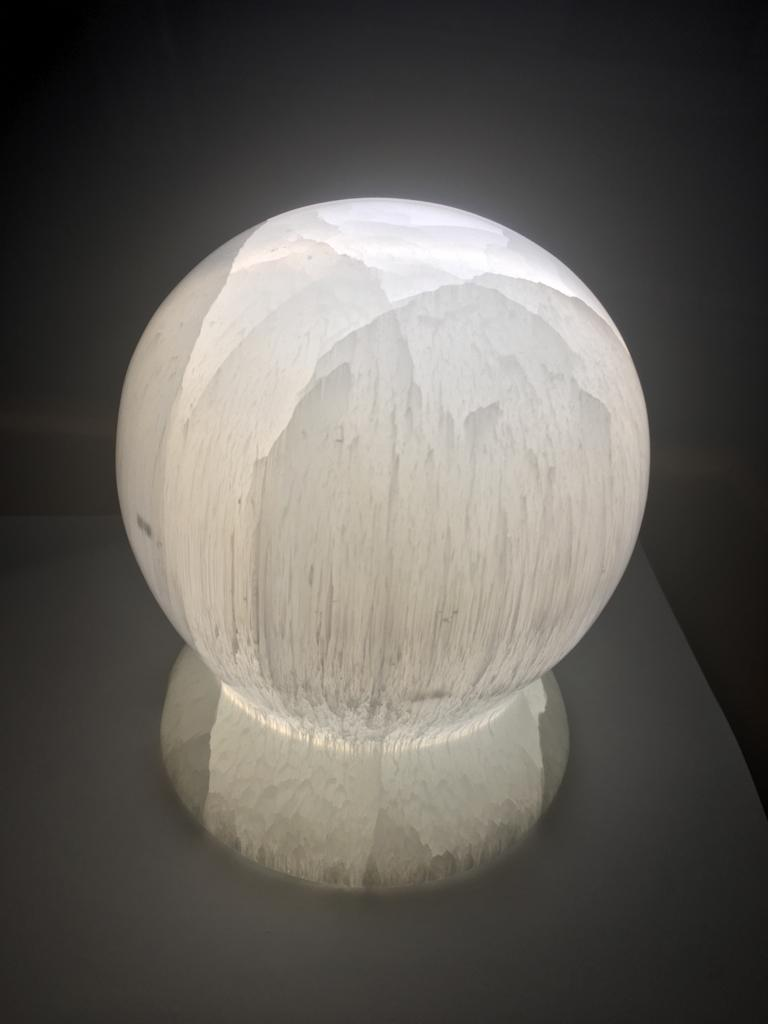
Yes. A selenite lamp is safe in normal household use. The stone is not toxic, not radioactive, and not an asbestos risk. The genuine cautions are mundane ones: selenite is soft enough to scratch with a fingernail, it dissolves in water, and a lamp sitting in a humid room can start to weep. Pets and small children need the same sense you would apply to any lamp.
That is the honest answer, and it is shorter than most pages on this question will give you. The longer version is worth reading, because two of the three real risks are things nobody warns you about until your lamp has already been damaged.
In this guide
- Are selenite lamps safe in everyday use?
- What a selenite lamp is actually made of
- Moisture is the real risk, and it ruins lamps
- Heat and electrical safety
- Pets, children and a stone you can scratch with a fingernail
- Dust, fibres, and what the evidence actually says
- Setting up a selenite lamp safely
- Frequently asked questions
- Choosing a lamp that will last
- A note on wellness claims
Are selenite lamps safe in everyday use?
For a lamp sitting on a shelf, a nightstand or a desk, there is no meaningful health hazard. Selenite is a form of gypsum, the same mineral in ordinary wall plaster, and it is chemically inert at room temperature. It does not off-gas. It does not leach. Handling it leaves nothing on your hands beyond a faint chalky feel.
The risks that do exist fall into four buckets, in rough order of how likely you are to meet them:
- Moisture damage to the stone itself, which is common and permanent
- Physical damage from knocks and drops, because the stone is very soft
- Electrical and heat risk, which belongs to the lamp fitting rather than the crystal
- Pets and children, where the hazard is swallowed fragments and a toppled lamp
None of these make a selenite lamp dangerous. All four are worth two minutes of attention when you decide where to put it.
What a selenite lamp is actually made of
This matters for every safety question that follows, so it is worth being precise.
Selenite is calcium sulfate dihydrate, chemical formula CaSO₄·2H₂O, better known as gypsum. On the Mohs hardness scale it sits at 2, which means your fingernail will scratch it and a copper coin certainly will. For comparison, quartz is a 7 and window glass is around 5.5. Selenite is one of the softest minerals you will ever own.
Almost every lamp, tower and wand sold as “selenite”, here and everywhere else, is strictly speaking satin spar, the fibrous variety of gypsum that gives the stone its silky lengthwise shimmer. True selenite in the mineralogical sense is the transparent, glassy variety. The trade has used the two names interchangeably for decades. Satin spar is what produces that soft internal glow when a bulb sits behind it, so it is the right material for a lamp. You can read a straightforward mineral description of both at minerals.net.
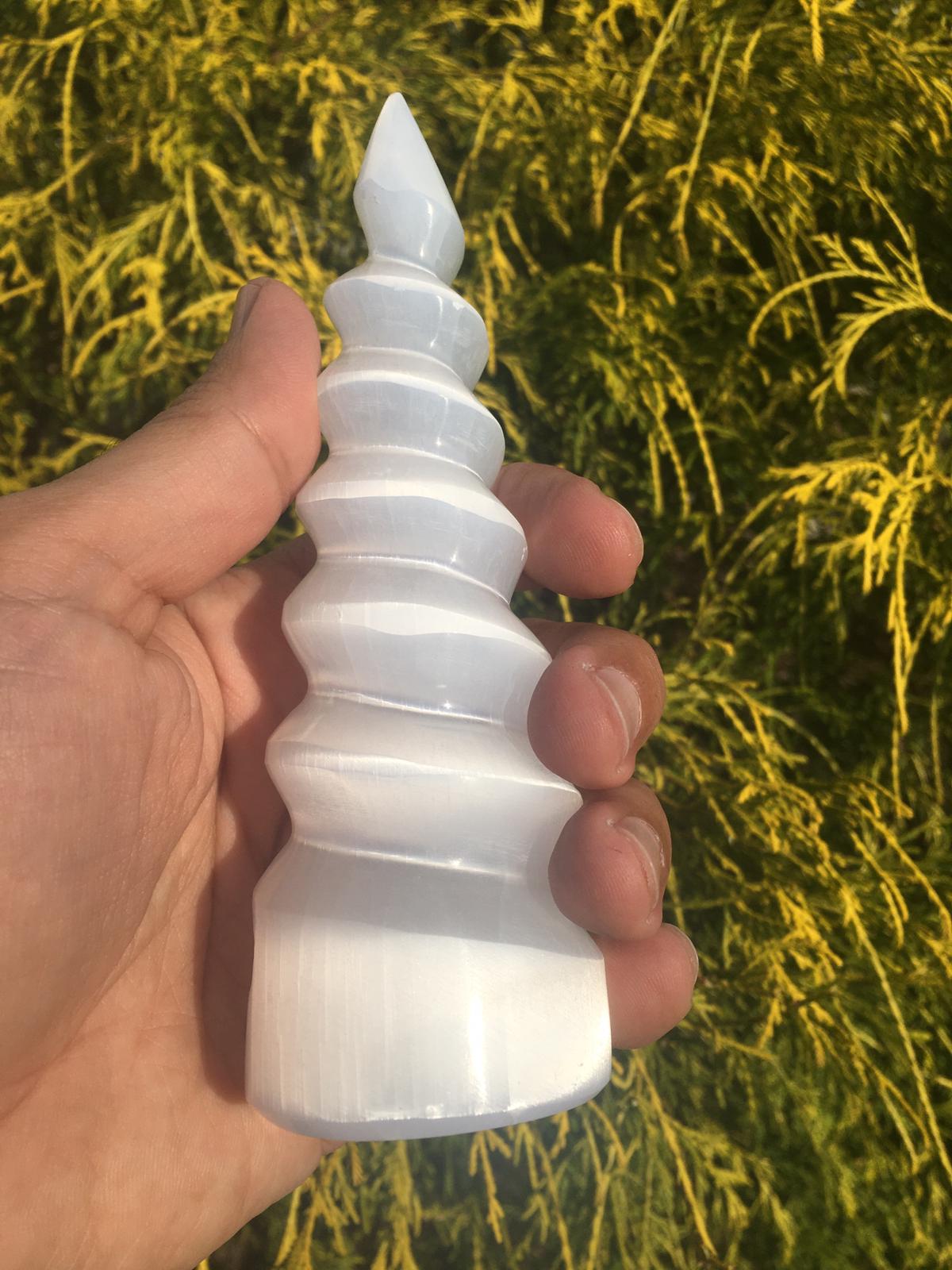
Two consequences follow from gypsum being gypsum, and they drive everything below: it is water-soluble, and it is hygroscopic, meaning it pulls moisture out of the air.
Moisture is the real risk, and it ruins lamps
This is the one that catches people out.
Gypsum dissolves slowly in water. Not dramatically, and not instantly, but a rinse under the tap will etch the polish, and a soak will visibly pit the surface and never recover. There is no repair for a water-damaged selenite piece. So the rules are absolute: no rinsing, no wiping with a wet cloth, no bathroom shelf next to a running shower, no dishwasher, ever. Dust it dry with a soft brush or a dry microfibre cloth.
Because gypsum is also hygroscopic, a lamp kept in a persistently humid room can absorb moisture from the air and develop beads of damp on its surface, sometimes leaving a faint white residue on the furniture underneath. People describe this as the lamp “sweating” or “leaking”, and it alarms them, understandably. It is not a crack, a leak from inside, or a defect in the wiring. It is the stone behaving the way gypsum behaves at high relative humidity.
The fix is placement. Keep a lamp out of bathrooms, laundry rooms, unheated basements and conservatories, and off any windowsill that collects condensation. Below roughly 50 percent relative humidity you will never see it. If your home runs damp, a small dehumidifier in that room solves the problem for every crystal you own, not just the lamp. Set the lamp on a coaster or a wooden base so that if it ever does bead, the moisture does not mark the furniture.
Warmth from the bulb actually helps here. A lamp that is switched on for a few hours a day keeps the stone slightly above ambient temperature and drier than its surroundings, which is why a lamp left unplugged in a damp room for months is the piece most likely to weep.
Heat and electrical safety
The crystal is not the hazard. The fitting is, exactly as with any other lamp.
Selenite does not burn and does not crack from the modest warmth of a domestic bulb. It does begin to lose its water of crystallisation at high temperature, but that happens well above anything a light fitting produces, so it is irrelevant in a home. A stone lamp will feel warm after a few hours. That is normal.
What matters is ordinary lamp sense:
- Use an LED bulb. It runs far cooler than an incandescent, draws less power, and will not overheat an enclosed stone shade. Most lamps of this type ship with a low-wattage fitting for exactly this reason.
- Do not exceed the rated wattage marked on the fitting.
- Check the cord and plug on arrival, and again every few months. Replace anything frayed rather than taping it.
- Switch it off when you leave the house or go to sleep, as you would any lamp. This is general advice about lamps, not something peculiar to selenite.
- Keep it clear of fabric. No draping a scarf over a shade for mood lighting.
Heavier pieces are the steadiest. A selenite sphere lamp sits in a cradle with a low centre of gravity and is hard to knock over. Tall shapes are more tippy by nature, so a tower lamp wants a spot where it cannot be caught by an elbow or a cat’s tail.

Pets, children and a stone you can scratch with a fingernail
Gypsum is not acutely toxic to cats or dogs. It is the primary ingredient in plaster and a common soil additive, and calcium sulfate is poorly absorbed in the gut. A pet that licks a selenite lamp is not poisoning itself.
The real hazards are mechanical, and they are the same ones you would weigh for any ornament:
- Swallowed fragments. Because the stone is so soft, a chewing dog can break off pieces. Those fragments can irritate the mouth and, if swallowed, cause stomach upset or in a worst case an obstruction. This is a vet visit, not a poisoning.
- A toppled lamp. A cat pushing a tall lamp off a shelf gives you a broken bulb, a live fitting and sharp stone fragments on the floor. This is by far the most likely accident in a house with animals.
- Cord chewing. The electrical cord is a greater risk to a pet than the crystal will ever be. Route it behind furniture or through a cord protector.
Practically: put lamps on stable surfaces at the back, not the front, of a shelf. Keep small tumbled pieces away from puppies and toddlers entirely, since a mini selenite tower is small enough to be a genuine choking hazard for a child under three. If a pet does swallow a fragment, call your vet or the ASPCA Animal Poison Control Center rather than waiting to see what happens.
Dust, fibres, and what the evidence actually says
Satin spar is fibrous, and that word understandably makes people think of asbestos. The comparison does not hold up.
Gypsum dust is treated by occupational health authorities as a nuisance particulate rather than a hazardous substance. Manufacturer safety data sheets for gypsum plaster classify the material as non-hazardous under standard workplace rules, while still advising against breathing concentrated dust, which is sensible guidance for any mineral powder. The animal studies that compared fibrous gypsum with asbestos-type fibres found gypsum produced a small fraction of the response. That research is old and limited, but it points the same direction as the regulatory treatment.
For a lamp on a shelf, this is academic. Intact polished stone sheds essentially nothing. The only time dust becomes a consideration is if you are cutting, sanding or drilling the stone, which generates fine airborne powder and calls for a mask and ventilation. Ordinary handling, dusting and display do not.
Selenite is also not radioactive, a question that comes up because a handful of minerals are. Gypsum contains no radioactive elements of note.
Setting up a selenite lamp safely
A short checklist that covers everything above:
- Pick a dry room. Living room, bedroom, office, hallway. Not the bathroom.
- Choose a stable surface at the back of a shelf, away from edges, doorways and tails.
- Fit a low-wattage LED bulb and stay within the rated wattage.
- Set it on a coaster or wooden base to protect the furniture.
- Route the cord out of reach of pets and children.
- Dust it dry only. Never water, never a damp cloth.
- Switch it off overnight and when you go out.
- Check the cord every few months.

If you want the glow without a cord anywhere near a curious animal, an unlit piece on a high shelf does the same decorative work. A polished spiral tower catches ambient light without being wired at all, and in a practice context a flat charging plate sits low enough that there is nothing to knock over.
For more on handling the stone day to day, see our guide to selenite benefits and uses and the overview of selenite’s properties and lore.
Frequently asked questions
Do selenite lamps leak
They do not leak in the sense of liquid escaping from inside. What people see is condensation: gypsum draws moisture from humid air and beads on the surface, sometimes leaving a chalky mark underneath. It is a sign the room is too damp, not that the lamp is faulty. Move it somewhere drier and the beading stops.
Are selenite lamps safe for cats
Yes, with two precautions. Gypsum is not acutely toxic, so licking is harmless, but a cat can knock a tall lamp down and can chew the cord. Place lamps at the back of a stable surface, secure the cord, and prefer a low, heavy shape such as a sphere over a tall tower in a household with climbers.
Can you leave a selenite lamp on all night
You can, and the stone will not be harmed, but the general advice for any lamp applies: switch it off when you sleep or leave the house. A cool-running LED bulb makes overnight use low risk if you want a night light. Unplug it if the cord or fitting shows any wear at all.
What happens if selenite gets wet
Water dissolves gypsum. A brief splash dulls the polish, and a soak etches and pits the surface permanently. There is no way to restore a water-damaged piece. If your lamp does get wet, pat it dry immediately with a soft dry cloth and let it air-dry away from heat, then accept that the finish may have changed.
Does a selenite lamp need a special bulb
No special bulb, but a low-wattage LED is the right choice. It runs cool inside an enclosed stone shade, uses little power, and lasts for years. Stay within the wattage printed on the fitting, and avoid high-wattage incandescent bulbs, which put unnecessary heat into a confined space.
Choosing a lamp that will last
If this has you looking, two things decide whether a lamp stays beautiful: a base you cannot knock over, and a dry place to put it. A sphere lamp sits low in its cradle and shrugs off a passing cat, which makes it the safer pick for a busy room or a low shelf. A tower lamp throws more light and more presence, and earns its place on a shelf that is out of reach. If you would rather skip the wiring entirely, the pineapple sphere lamp is the most forgiving shape we cut.
Every piece is natural selenite, cut and finished by hand, and ships from the US in 1 to 3 business days.
A note on wellness claims
Selenite is a beautiful mineral with a long history in spiritual practice, and many people find working with it genuinely meaningful. That said, crystal healing is not supported by scientific evidence, and nothing here is medical advice. Selenite cannot diagnose, treat, cure or prevent any illness. If you are dealing with a health concern, please talk to a qualified healthcare professional — a crystal is a lovely companion to real care, never a replacement for it.
