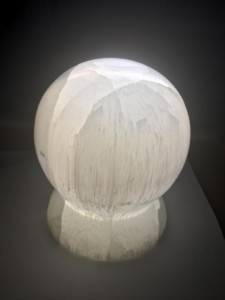
A selenite bowl is a shallow carved dish used to hold crystals, jewellery or small everyday objects, and in crystal practice it doubles as somewhere to clear them. The appeal is practical before it is spiritual: a bowl gathers a loose collection into one place where nothing rolls off the shelf and nothing chips against anything else.
There is a catch, and it is the reason a lot of people end up owning both a bowl and a plate. A bowl is better at storing than it is at clearing. The difference comes down to contact, and it is worth understanding before you buy.
In this guide
- What a selenite bowl is actually for
- Bowl or plate? The honest difference
- What fits in each size
- The one thing that ruins a selenite bowl
- Do the carved shapes matter?
- How often to clear what is in the bowl
- Living with a bowl that holds jewellery
- Frequently asked questions
- Choosing your first selenite bowl
- A note on wellness claims
What a selenite bowl is actually for
Three jobs, in roughly the order people use them for.
Storage. Loose tumbles in a drawer knock together. Selenite, fluorite and calcite are soft enough that this leaves marks. A bowl keeps a collection in one place, visible, and stops the quiet attrition of stones chipping each other.
Clearing. In crystal tradition, selenite is treated as a stone that resets others without needing resetting itself. Resting a piece against selenite is the gesture. That is a belief rather than a measurable process, and worth stating plainly, but the ritual is meaningful to a lot of people and the bowl is the least effortful way to perform it.
Everyday catch-all. Rings by the sink, earrings at the bedside, a watch. This is the use people are faintly embarrassed about and do the most. It is also the one where the material matters least and the shape matters most.

Bowl or plate? The honest difference
A bowl gathers; a plate presents. That sounds like decoration, but it has a real consequence.
Drop a dozen tumbles into a bowl and they form a heap. Only the stones at the bottom and sides touch the selenite. The ones on top are touching each other. If the point of the exercise is contact with selenite, a heap defeats it.
A plate holds everything in a single flat layer, so every piece touches. That is why our guide to using a selenite charging plate makes the flat surface the whole point rather than a style choice.
So:
- Clearing a collection, or building a grid — a plate.
- Storing, displaying, keeping a bedside catch-all — a bowl.
- Both, which is most people — a bowl on the dresser, a plate on the shelf.
If you are only buying one and you are honest that it will mostly hold jewellery, buy the bowl.
What fits in each size
Measure your largest piece before choosing. This is where people go wrong, and a bowl that is slightly too small is annoying forever.
| Size | Comfortably holds |
|---|---|
| 4 inch | 10-15 small tumbles, or a few rings and a pendant |
| 4.5-5 inch | 20-25 tumbles, or 2-3 palm stones, or a day’s jewellery |
| 6 inch and above | A mixed collection, a small cluster, or several palm stones |
Depth matters as much as width. A shallow dish shows what is in it; a deep one hides the bottom layer and becomes a place things get lost. For jewellery, shallow wins. For a lot of tumbles, depth earns its keep.
The 4.5 inch charging bowl sits in the middle of that range and is the size most people reach for first. A round bowl in the same family does the same job with a plainer profile.
The one thing that ruins a selenite bowl
Water. Never put any in it, and never wash it.
Selenite is gypsum, calcium sulfate dihydrate, and gypsum dissolves — roughly two grams of it will vanish into a litre of water. A rinse dulls the polish. A soak pits the surface permanently, and there is no repair. The full chemistry is covered in our piece on whether selenite can go in water, and a plain mineral description is on geology.com.
This matters more for bowls than for any other shape, because a bowl looks like a dish. It invites exactly the wrong instinct. Specifically:
- No water, no flowers, no floating candles.
- No damp jewellery. Take rings off before washing up, not after.
- Not in a bathroom, where humidity alone will raise a chalky bloom over months.
- Dust it with a dry soft brush. That is the entire maintenance schedule.
Selenite is also a 2 on the Mohs scale, soft enough that a fingernail marks it, so set heavy or sharp-edged pieces down rather than dropping them in.
Do the carved shapes matter?
Functionally, no. A heart, a star and a circle of the same width hold about the same amount, and none of them clears anything better than the others.
What the shapes change is where a bowl looks right. A round or oval bowl disappears into a room and works anywhere. A heart bowl reads as a gift and tends to end up on a dresser rather than an altar. A star has points that catch dust and are the first part to chip, which is worth knowing before you put one somewhere busy.

Grain varies piece to piece because these are cut from natural stone. Two bowls of the same shape will not match, which is either the appeal or the problem depending on your temperament.
How often to clear what is in the bowl
There is no schedule you can get wrong, because this is a practice rather than a maintenance task. Still, the question comes up constantly, so here is what people actually do.
For stones carried or worn daily, once a week is the common rhythm. For a collection that sits on a shelf and is rarely handled, once a month is plenty. After something that felt heavy, a difficult week or a crowded house, people tend to clear everything at once, and a bowl is the least effortful way to do that.
The bowl itself never needs clearing. Selenite is described as self-clearing in the same tradition that gives the bowl its purpose, which is the whole reason it gets used on other stones.
One practical note that applies regardless of belief: rotating the contents occasionally is worth doing. Stones at the bottom of a heap collect dust and stay there for months, and the ones on top get handled and chipped. Tipping the bowl out every few weeks, wiping the inside dry and refilling it keeps the collection in better condition than leaving it undisturbed.
Living with a bowl that holds jewellery
The most common real-world use deserves its own rules.
Metal is harder than selenite. A ring dropped from a height marks the surface, and over a year of daily use the inside of a jewellery bowl goes visibly matte. That is not damage so much as patina, and most people stop noticing. If you mind, put a small cloth in the base.
Silver will tarnish at its normal rate; selenite does nothing to prevent that, whatever you may read. And take pieces off before the shower rather than dropping wet metal in, since moisture is the one thing the bowl genuinely cannot take.
Frequently asked questions
What is a selenite bowl used for
Holding and storing crystals, jewellery or small objects, and in crystal practice, clearing the stones kept in it. The practical benefit is that a collection stays in one place instead of knocking about in a drawer, which matters because soft stones chip each other. The clearing use is traditional rather than measurable.
Can you put water in a selenite bowl
No. Selenite is a form of gypsum and dissolves in water, so a rinse dulls the polish and standing water pits the surface permanently. That rules out flowers, floating candles and washing it. Dust it with a dry soft brush instead, which is all the cleaning it ever needs.
What is the difference between a selenite bowl and a charging plate
A bowl gathers stones into a heap, so only the bottom layer touches the selenite. A plate holds everything in one flat layer, so every piece is in contact. Use a plate for clearing and for grids, and a bowl for storage, display and jewellery.
Can you put jewellery in a selenite bowl
Yes, and it is the most common use. Keep the metal dry, and be aware that metal is harder than selenite, so the inside of a daily-use bowl will go matte over time. A small cloth in the base prevents it if that bothers you.
How do you clean a selenite bowl
Dry methods only. A soft dry brush, the sort used for camera lenses, lifts dust without scratching the surface. Never use water, damp cloths or cleaning products. If a chalky film appears, that is the stone reacting to humidity, so move it somewhere drier.
Choosing your first selenite bowl
Start from what it will actually hold. A bedside catch-all for rings and a pendant wants something shallow and about 4 inches. A growing tumble collection wants the 4.5 inch charging bowl or larger. If it is a gift, a carved heart says more than a plain circle does. The full range sits in our bowls collection.
Every bowl is cut and finished by hand from natural selenite, so the fibres and the weight differ piece to piece. Orders ship from the US in 1 to 3 business days.
A note on wellness claims
Selenite is a beautiful mineral with a long history in spiritual practice, and many people find working with it genuinely meaningful. That said, crystal healing is not supported by scientific evidence, and nothing here is medical advice. Selenite cannot diagnose, treat, cure or prevent any illness. If you are dealing with a health concern, please talk to a qualified healthcare professional — a crystal is a lovely companion to real care, never a replacement for it.