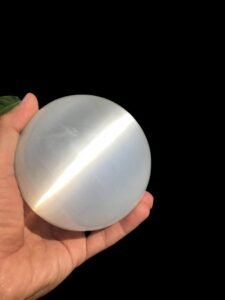
A selenite tower is a length of selenite cut flat at the base and tapered or domed at the top, so it stands upright on its own. That is the whole of the definition. The shape has no special properties the same stone would lack lying down; what it has is presence, stability and a top surface that catches light.
Towers get bought for one of two reasons. Either someone wants a piece of selenite that reads as an object in a room rather than a stone in a dish, or they want the upright form for a grid or an altar. Both are good reasons. Neither requires believing anything in particular.
In this guide
- What a selenite tower actually is
- Tower, lamp or wand: what the shapes are for
- Why towers tip over, and what to do about it
- Choosing a height
- Where to put a selenite tower
- Towers in a crystal grid
- Does the cut change anything?
- The two things that damage a tower
- Frequently asked questions
- Choosing a tower you will keep
- A note on wellness claims
What a selenite tower actually is
Mechanically, a tower is a wand that has been given a flat foot. The cut is the product.
The stone itself is gypsum, and almost everything sold as selenite — towers very much included, is strictly satin spar, the fibrous variety. The fibres run the length of the piece, which is why a tower glows along its height when light hits it from the side, and why the top face looks like the end of a bundle of threads. True selenite is the transparent, glassy form, and the trade has used the two names interchangeably for decades. Geology.com has a plain description of the whole gypsum family if you want the mineralogy without the marketing.
Height is the main variable. Small towers of a few inches sit on a desk and get handled. Larger ones, a foot or more, become furniture and stop being picked up at all.

Tower, lamp or wand: what the shapes are for
These three get confused constantly, and shops are not always helpful about it.
| Shape | What it is | Best for |
|---|---|---|
| Tower | Stands upright, flat base, no electrics | Display, grids, altar work |
| Lamp | A tower or sphere drilled for a bulb | Light, ambience, a warm glow |
| Wand | Hand-length, not designed to stand | Holding, body work, directing |
A lamp is a tower with a hole in the bottom and a low-wattage bulb. That changes the care requirements significantly, because warmth plus humidity is what makes selenite weep. Our guide to whether selenite lamps are safe covers that in detail.
A tower with no electrics has none of those problems. It is the lowest-maintenance selenite shape there is, which is worth something.
Why towers tip over, and what to do about it
This is the thing nobody mentions, and it accounts for most broken towers.
A tower is tall, narrow and top-heavy relative to its footprint, and it is made of a mineral that sits at 2 on the Mohs scale, soft enough to mark with a fingernail. A knock that a quartz point would shrug off takes a corner off a selenite tower.
Three habits prevent almost all of it:
- Back of the surface, not the front. Towers get caught by sleeves and cloths. Six inches further back is enough.
- Never on a speaker, a washing machine, or anything that vibrates. Slow walking is real, and a tower walks to the edge over weeks.
- Lift from the middle, not the top. The top is the narrowest point and the fibres run the wrong way for it.
If one does fall and snap, the break will usually run along the fibres and be surprisingly clean. People keep the base as a shorter tower and the top as a pocket piece, which costs nothing.
Choosing a height
Height decides where a tower can live more than anything else.
| Height | Suits |
|---|---|
| 2-4 inch | A desk, a bedside table, a grid centre |
| 4-8 inch | A shelf or mantelpiece, the usual first purchase |
| 8 inch and up | A floor, a hearth, a dedicated surface |
A mini tower is the one to get if it will be handled, moved around, or used as the focus of a grid you rebuild often. A full-height tower is the one that stays put and becomes part of the room. If you want the fibre effect exaggerated, a polished spiral tower twists the grain so the light moves as you walk past it.
Where to put a selenite tower
Practical considerations first, because they are the ones that actually affect the stone.
Away from damp. Not a bathroom, not a kitchen windowsill above a kettle, not a conservatory that gets condensation. Gypsum draws moisture from humid air and develops a chalky bloom over months. This is slow, cumulative and irreversible.
Out of direct sun. Selenite will not fade the way amethyst does, but years of strong sun make it brittle at the surface.
Somewhere with side light. The whole visual point of a tower is the fibres lighting up, which needs light coming across the piece rather than straight down on it. A tower in a dim corner is just a white rock.
In crystal practice, towers are commonly placed at entrances, in corners, or at the centre of a grid, on the idea that an upright form marks a point in a space. That is tradition rather than physics, and people who find it useful tend to find it useful regardless.
Towers in a crystal grid
The upright shape is why towers end up at the centre of grids. A flat stone marks a spot; a tower marks it in three dimensions and is easy to orient deliberately.
The usual arrangement is a tower in the middle of an engraved charging plate, with supporting stones set on the engraved lines around it. Leave a grid in place for as long as the intention is live — days or weeks, not hours, which is why it is worth having a plate you are not also using for nightly clearing.
One practical note: a tower on a plate is two soft stones in contact. Set it down, do not slide it, or you will scratch the plate.

Does the cut change anything?
Not physically. A spiral, a flat-faced obelisk and a rounded pillar of the same stone behave identically, dissolve identically and mark identically.
What the cut changes is how the fibres meet the surface, and therefore how light behaves. A plain tower glows evenly along its length. A spiral breaks that into bands that shift as you move, which is why spirals photograph well and why they look livelier in a room with changing light. A flat-faced obelisk gives you clean edges and a sharper silhouette, at the cost of corners that are the first thing to chip.
Pick on looks, in other words, and ignore anyone who tells you one cut focuses energy better than another. That claim is not part of any old tradition; it is a sales line.
The two things that damage a tower
Everything else is cosmetic.
Water, in any form. Selenite dissolves — about two grams per litre, so a rinse takes the polish off and a soak pits the surface for good. There is no sealant that fixes it. The detail is in our piece on whether selenite can go in water.
Heat applied quickly. Gypsum holds water inside its crystal structure, and driving that out makes it crumble. That means no hairdryers, no radiators, and nothing left on a hot windowsill in summer.
Dusting is the entire maintenance routine: a dry soft brush, occasionally, along the fibres rather than across them.
Frequently asked questions
What is a selenite tower used for
Display, altar and grid work, mainly. In crystal practice an upright piece is used to mark a point in a room or anchor the centre of a grid, and selenite specifically is treated as a stone that clears others. Practically, a tower is also the easiest selenite shape to own, because without electrics there is nothing to go wrong.
What is the difference between a selenite tower and a lamp
A lamp is a tower drilled for a bulb. The stone is the same; the hole and the fitting are the difference. A lamp gives light and warmth, which also means it needs more care, since warmth plus humidity is what makes selenite weep. A plain tower has none of those concerns.
Do selenite towers need cleansing
In the tradition that gives them their purpose, no. Selenite is described as self-clearing, which is the reason it gets used to clear other stones. Practically, a tower needs dusting with a dry soft brush now and then, and nothing else at all.
Can a selenite tower go in water
No. Selenite is a form of gypsum and dissolves. A rinse dulls the polish and a soak pits the surface permanently, with no way to restore it. Keep towers out of bathrooms and away from humid air, which does the same damage slowly.
Why did my selenite tower turn chalky
It has been absorbing moisture from the air. A white powdery film is gypsum reacting to humidity, and it will keep returning until the piece moves somewhere drier. Brush it off dry and relocate the tower away from bathrooms, kettles and windows that gather condensation.
Choosing a tower you will keep
Decide where it is going before you decide how big. A surface people walk past wants something short and set back; a shelf at eye level is where a taller piece earns its price, because that is where the fibres actually catch light. If it is going in the middle of a grid, smaller is better, since you will be moving it.
Browse the full range in our lamps and towers collection. Every piece is cut and polished by hand from natural selenite, so height, grain and weight vary. Orders ship from the US in 1 to 3 business days, packed for a stone that genuinely needs the padding.
A note on wellness claims
Selenite is a beautiful mineral with a long history in spiritual practice, and many people find working with it genuinely meaningful. That said, crystal healing is not supported by scientific evidence, and nothing here is medical advice. Selenite cannot diagnose, treat, cure or prevent any illness. If you are dealing with a health concern, please talk to a qualified healthcare professional — a crystal is a lovely companion to real care, never a replacement for it.