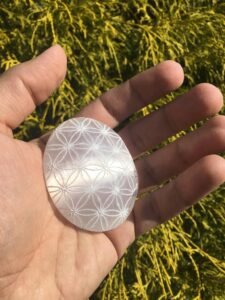
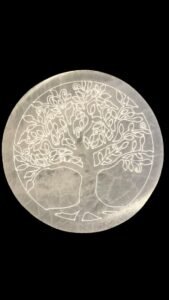
A selenite wand is a hand-length piece of selenite, usually six to eight inches, shaped so it sits comfortably in a closed hand. Some are rounded, some faceted, some tapered to a point. What makes it a wand rather than a tower is simply that it is meant to be held rather than stood up.
In practice people use one for three things: clearing other crystals, sweeping the air around the body in a practice sometimes called aura combing, and marking direction in a crystal grid. All three are traditions rather than measurable processes, and a wand does not need to be doing anything physical for the holding of it to be the point.
In this guide
- What a selenite wand is, and is not
- How to hold and use one
- Wand, tower or plate: which does which
- Using a wand for massage
- Why wands break, and how to avoid it
- Carrying a wand without destroying it
- Care, which is briefer than you expect
- Frequently asked questions
- Choosing a wand you will actually reach for
- A note on wellness claims
What a selenite wand is, and is not
The stone is gypsum, and like almost everything sold as selenite, a wand is usually satin spar, the fibrous variety. The fibres run the length of the piece, which is what gives a wand its silky lengthwise shine and also, as we will get to, its one structural weakness.
A wand is not a different mineral from a tower, a plate or a tumble. It has no properties the same stone lacks in another shape. What it has is ergonomics. A six-inch bar fits a hand; a charging plate does not. If your practice involves holding something, the wand is the shape that was cut for it.
Sizes cluster around a useful range. Under four inches and it handles like a tumble. Over about ten and the leverage starts working against the stone.
How to hold and use one
There is no correct grip, which is worth saying because a lot of pages imply there is.
Most people hold a wand loosely in the dominant hand, thumb along the length, with the tip pointing away from the body. A loose grip matters more than a particular one: squeezing a soft stone against a hard ring is how chips happen.
For the three common practices:
- Clearing other stones. Rest the wand across or beside the crystal and leave it a few minutes, or pass it slowly over the piece. Contact is the gesture, not pressure.
- Sweeping. Hold the wand a few inches from the body and move it slowly from head to feet, usually downward and outward. Nothing touches the skin.
- Grid work. Lay the wand pointing inward from the edge of a grid toward the centre stone, to mark direction. Several wands can radiate inward like spokes.

Wand, tower or plate: which does which
These overlap enough that people buy the wrong one.
| Shape | Held? | Best at |
|---|---|---|
| Wand | Yes | Sweeping, grid direction, carrying |
| Tower | No | Standing display, anchoring a grid centre |
| Plate | No | Clearing several stones at once, flat |

If you want to clear a whole collection in one go, a charging plate does it in one layer while a wand does it one stone at a time. If you want something upright in a room, our guide to what a selenite tower is covers that shape properly. The wand earns its place when the practice involves your hands.
Using a wand for massage
Some wands, including rounded and chakra-engraved ones, are sold as massage tools. This is worth being precise about.
What a selenite wand genuinely is: a smooth, cool, lightweight object that is pleasant to draw across skin, particularly on the face and jaw. People find it relaxing in the same way a cold spoon or a jade roller is relaxing. That is a real and perfectly good reason to own one.
What it is not: a treatment for anything. Selenite cannot address a medical or psychological condition, and no crystal can. If a page tells you otherwise, close it.
Practical cautions, since this is the use with the most ways to go wrong:
- Light pressure only. Selenite sits at 2 on the Mohs scale, softer than a fingernail. Pressing hard marks the stone and does nothing useful for you.
- Dry skin, dry stone. No oils, no serums, no damp faces. Oil soaks into the fibres and will not come out, and moisture dissolves the surface.
- Wipe with a dry cloth afterwards, never a damp wipe.
If you want a stone for use with oils or a cleansed face, selenite is the wrong mineral. A quartz or jade tool will take the moisture; selenite will not.
Why wands break, and how to avoid it
Wands snap more than any other selenite shape, and the reason is geometry rather than bad luck.
The fibres run lengthwise, so a wand is strong along its length and weak across it. It is also long, thin and unsupported in the middle when you hold it at one end. Add a surface at Mohs 2 and you have a piece that a single knock against a table edge will take out.
Three habits prevent most breaks:
- Carry it in the middle, not by one end.
- Set it down flat, never standing in a jar with other crystals where it can fall against something harder.
- Store it alone, or wrapped. A drawer with quartz points in it will scratch a wand to matte within weeks.
If one does break, the fracture usually runs clean across the fibres. People keep both halves as shorter wands or pocket pieces, which is genuinely what most of them become.
Carrying a wand without destroying it
A wand is the selenite shape people most want to take with them, and the one least suited to it.
A bag contains keys, coins and zips, all of which are harder than Mohs 2. A wand loose in a handbag will be matte within a fortnight and chipped within a month. If you want to carry one, it needs its own sleeve: a soft pouch, a sunglasses case, or a wrap of cloth. Anything that keeps it away from metal.
For pockets specifically, a wand is the wrong choice. The length means it sits across the hip and takes the impact every time you sit down. A tumble or a palm stone survives pocket life; a wand does not.
Care, which is briefer than you expect
Keep it dry and keep it away from heat. That is the whole routine.
Selenite dissolves in water, about two grams per litre, so a rinse takes the polish off and a soak pits the surface for good. Our piece on whether selenite can go in water covers the chemistry. Geology.com has a plain description of gypsum if you want it from a mineral source rather than a shop.
Dust along the fibres with a dry soft brush, not across them. In crystal tradition the wand itself never needs clearing, since selenite is the stone described as self-clearing and is used on others for that reason.
Frequently asked questions
What is a selenite wand used for
Clearing other crystals, sweeping the air around the body, and marking direction in a crystal grid. All three are traditional practices rather than measurable effects. A wand is simply the shape of selenite cut to be held, so it suits any practice that involves your hands rather than a surface.
How do you cleanse a selenite wand
You do not need to, according to the tradition that gives it its purpose: selenite is described as self-clearing, which is why it gets used on other stones. Practically, a wand needs dusting with a dry soft brush occasionally. Never use water, which dissolves the surface permanently.
Can you use a selenite wand on your face
Gently, and dry. A smooth wand is cool and pleasant to draw across the skin, which many people find relaxing. Use no oils or serums, since oil soaks into the fibres and will not come out, and keep the pressure light because selenite marks easily. It is not a treatment for anything.
Which way do you point a selenite wand
There is no fixed rule. The common convention is to point the tip away from the body when sweeping, and inward toward the centre stone when laying wands in a grid. Different traditions give different answers, so follow whichever one you are working within.
Why did my selenite wand break in half
Because the fibres run lengthwise, which makes a wand strong along its length and weak across it. Combined with a surface hardness of 2 on the Mohs scale, a single knock against a hard edge is usually enough. Carrying it by the middle and storing it flat prevents most breaks.
Choosing a wand you will actually reach for
Size is the decision. If it will live in a pocket or a bag, shorter and rounder survives better. If it is for grid work and will mostly lie still, a longer tapered piece looks right and will not be handled enough to be at risk.
An engraved chakra wand suits a practice built around chakra work, since the markings give you fixed points to work along. A pointed engraved wand is the better choice for grids, where direction is the whole idea. Both sit in our wands collection.
Each wand is cut and finished by hand, so the grain and the weight differ piece to piece. Orders ship from the US in 1 to 3 business days, wrapped properly, because this is the shape that least enjoys a rough journey.
A note on wellness claims
Selenite is a beautiful mineral with a long history in spiritual practice, and many people find working with it genuinely meaningful. That said, crystal healing is not supported by scientific evidence, and nothing here is medical advice. Selenite cannot diagnose, treat, cure or prevent any illness. If you are dealing with a health concern, please talk to a qualified healthcare professional — a crystal is a lovely companion to real care, never a replacement for it.