A selenite palm stone is a smooth, flattened oval of selenite, usually two to three inches across, cut to sit in a closed hand with the thumb resting on top. The shape is the product. Unlike a tower or a plate, a palm stone is not designed to be looked at; it is designed to be held, often absently, often for a long time.
That makes it the most-used piece in a lot of collections and the one most likely to end up chipped. Selenite is soft, and a stone you carry is a stone you drop.
In this guide
- What a selenite palm stone is for
- Where the worry stone tradition comes from
- How to actually hold one
- Palm stone, tumble or heart: which to pick
- How long to hold one
- The pocket problem
- Care, in one paragraph
- Frequently asked questions
- Choosing one you will actually use
- A note on wellness claims
What a selenite palm stone is for
The honest answer is that the holding is the point.
In crystal practice, selenite is associated with clarity and with clearing, and a palm stone is the form you use when the practice involves your hands rather than a surface: meditation, a few minutes of stillness before something difficult, or simply having something to turn over while thinking. Those associations are traditional rather than demonstrated, and they do not need to be true for the object to be useful.
What is straightforwardly true is the physical part. A smooth, cool, slightly heavy object in the hand gives you something to do with your attention. People have used worry stones, prayer beads and turned-over coins for exactly this for a very long time, across cultures that had no contact with each other. The crystal is a modern entry in an old category.
Where the worry stone tradition comes from
The flattened thumb-stone is not a crystal-shop invention.
Smooth stones with a thumb-sized depression appear in ancient Greece, where worry beads and worry stones both have a long history, and comparable objects turn up in Tibetan and Irish traditions. The common thread is a repeated, small, physical action that occupies the hands.
Modern crystal practice layered mineral associations onto that older habit. The selenite palm stone is therefore doing two things at once: a very old thing, which is giving restless hands a job, and a much newer thing, which is the energetic framing. Both are fine. It is worth knowing which is which.

How to actually hold one
There is no correct technique, but there is a common one.
Rest the stone in the palm of the non-dominant hand and place the thumb of the same hand on the upper face. Move the thumb slowly across the surface, or simply let it rest. Some people pair this with counted breathing: four in, four out, one pass of the thumb per breath.
For a more structured sit, the usual approach is to hold the stone still rather than rubbing it, with the hands in the lap, and return attention to the weight of it whenever thinking wanders. That is the same instruction a meditation teacher would give for a breath anchor, with an object standing in.
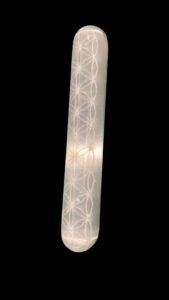
Engraved stones, like one carved with a Flower of Life, give the thumb a texture to follow, which some people find easier to settle with than a plain polished face.
Palm stone, tumble or heart: which to pick
These three overlap, and the differences are mostly ergonomic.
| Shape | Size | Suits |
|---|---|---|
| Tumble | Under 1.5 inch | Pockets, grids, collecting |
| Palm stone | 2-3 inch, flattened | Holding for long periods |
| Heart | 2-3 inch, rounded | Gifts, display, holding |
A tumble is too small to occupy a whole hand and tends to get fidgeted with rather than held. A palm-size heart does the same job as a palm stone with a different silhouette, and is the one people buy for someone else. Rhombus tumbles are the better choice if you want several small pieces rather than one good one.

If your practice involves sweeping or directing rather than holding, the shape you want is a wand instead — our guide to using a selenite wand covers that.
How long to hold one
Longer than people expect, and there is no upper limit.
A few minutes is enough to notice the weight and temperature change in your hand, which is the part most people are actually after. Ten to twenty minutes is the usual range for a seated practice. Some people keep a stone in hand for a whole film without thinking about it, which is fine and probably the most honest version of the whole thing.
The one physical note: selenite warms to body temperature within a couple of minutes and stays there. If the coolness is what you like about it, put it down periodically rather than holding it continuously, and it will come back.
There is no schedule, no minimum, and nothing you can do wrong. Anyone telling you a palm stone must be held for a set number of minutes to work is adding rules that no tradition actually contains.
The pocket problem
Here is the caution that matters, and it contradicts how these are usually marketed.
Palm stones are sold as pieces to carry. Selenite is a poor choice for carrying, and a trouser pocket is the worst option available. The reasons are specific:
- Keys and coins are harder. Selenite sits at 2 on the Mohs scale. Steel is around 4 to 4.5, and a single key will score it.
- Pockets get sat on. A flattened oval takes the load across its thinnest axis, which is where it snaps.
- Pockets are humid. Body heat plus moisture raises a chalky bloom on gypsum over weeks, and the surface never fully recovers.
If you want to carry one, give it a soft pouch and a bag rather than a pocket. If you genuinely want a crystal that survives daily pocket life, a quartz tumble will, and selenite will not. Saying so costs us a sale and is still the right advice.
Care, in one paragraph
Keep it dry and keep heat away from it. Selenite dissolves in water at roughly two grams per litre, so hand-washing with the stone still held, damp hands, or a rinse to “clean” it will dull the surface permanently — the detail is in our piece on whether selenite can go in water. Skin oils build up on a stone handled daily and can be lifted with a dry soft cloth, never a damp one. If you want the mineral background from a non-shop source, geology.com describes gypsum plainly. And if the whole satin spar question is nagging at you, our piece on selenite versus satin spar settles it.
Frequently asked questions
What is a selenite palm stone used for
Holding, mainly: meditation, moments of stillness, or simply occupying restless hands. In crystal practice selenite is associated with clarity and clearing, so the stone is used as a focus during that work. The associations are traditional rather than demonstrated, but the physical habit of holding a smooth object is very old and genuinely settling for many people.
How do you use a selenite palm stone for anxiety
People use palm stones the way worry stones have always been used: resting the thumb on the surface and moving it slowly, often paired with counted breathing. That is a self-soothing habit rather than a treatment, and selenite cannot address a medical or psychological condition. If anxiety is affecting your daily life, please speak to a qualified professional.
Can you carry a selenite palm stone in your pocket
It is the worst place for one. Selenite is Mohs 2, so keys and coins scratch it immediately, pockets get sat on and a flattened stone snaps across its thinnest axis, and body humidity raises a chalky bloom over weeks. Use a soft pouch in a bag instead.
How do you clean a selenite palm stone
Dry methods only. A soft dry cloth lifts skin oils from a stone that is handled often, and a dry soft brush deals with dust. Never use water, damp wipes or cleaning products, because gypsum dissolves and the dulling cannot be reversed.
What is the difference between a palm stone and a tumble
Size and intent. A tumble is usually under an inch and a half and suits pockets, grids and collecting. A palm stone is two to three inches and flattened so it fills a closed hand, which is what makes it comfortable to hold for long periods rather than fidget with.
Choosing one you will actually use
Weight decides this more than looks. A palm stone that is too light feels like a pebble and gets put down; one that is too heavy stops being comfortable after a few minutes. Two to three inches across, with some thickness to it, is the range most people settle on. If you can, hold one before deciding, because the difference between a stone you reach for and one you forget is almost entirely how it sits in your hand.
A Flower of Life engraved palm stone gives the thumb something to follow. A natural orange selenite tumble is the warmer-coloured option, taking its peach tone from iron in the stone. Both sit in our palm stone collection.
Each one is cut and finished by hand, so no two have the same grain or sit in the hand quite the same way. Orders ship from the US in 1 to 3 business days.
A note on wellness claims
Selenite is a beautiful mineral with a long history in spiritual practice, and many people find working with it genuinely meaningful. That said, crystal healing is not supported by scientific evidence, and nothing here is medical advice. Selenite cannot diagnose, treat, cure or prevent any illness. If you are dealing with a health concern, please talk to a qualified healthcare professional — a crystal is a lovely companion to real care, never a replacement for it.