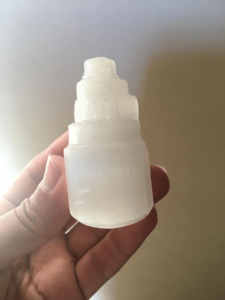
Selenite vs satin spar comes down to this: both are gypsum, the same mineral with the same chemistry, but they are different habits of it. Satin spar is the fibrous, silky, milky-white form. Selenite proper is the transparent, glassy form you can almost read through. Almost everything sold as selenite, including towers, plates, wands and bowls, is satin spar.
That is not a scam and you have not been cheated. The trade has used the two names interchangeably for decades, and the distinction matters far less than most identification posts suggest. But it is real, it is visible, and it takes about three seconds to check.
In this guide
- One mineral, three habits
- How to tell which one you own
- Why the trade blurred the names
- Does the difference change the price?
- Where satin spar comes from
- Selenite vs satin spar: does it change how you look after it?
- The other names you will see
- Frequently asked questions
- Choosing a piece, whichever it is called
- A note on wellness claims
One mineral, three habits
Gypsum is calcium sulfate dihydrate, CaSO₄·2H₂O. It crystallises in several distinct forms depending on how it grew, and mineralogists call these habits.
| Habit | Looks like | Common name |
|---|---|---|
| Fibrous | Silky, milky, parallel threads | Satin spar |
| Tabular, transparent | Clear, glassy, sometimes bookish layers | Selenite |
| Massive, fine-grained | Dense, opaque, marble-like | Alabaster |
| Rosette clusters | Sandy petals | Desert rose |
All four are gypsum. All four are hardness 2 on the Mohs scale. All four dissolve in water. If you learn nothing else, learn that last part, because it applies to every piece on that list regardless of what the label says. Geology.com lays out the full family, and minerals.net has a focused description of satin spar specifically.
How to tell which one you own
Three checks, no equipment.
1. Look for the fibres. Hold the piece under a light and turn it. Satin spar shows parallel lines running in one direction, like the grain in a bundle of threads, and the shine travels across the stone as you turn it — the same effect as a cat’s eye. Selenite proper has no fibres at all.
2. Try to see through it. Put the piece over printed text. Clear selenite will let you make out the letters, at least through a thin section. Satin spar is translucent at best: light passes through, images do not.
3. Check the shine. Satin spar is satiny and soft-edged, which is where the name comes from. Selenite is glassy and sharp, closer to a window than a silk ribbon.

If the shine moves and you cannot read through it, it is satin spar. That covers the overwhelming majority of pieces in circulation.
Why the trade blurred the names
Not out of dishonesty, mostly out of momentum.
Satin spar began appearing in large volumes from Morocco in the 1990s and 2000s, and it arrived into a market that already knew the word “selenite” and associated it with moonlight and clarity. “Selenite” sells. “Satin spar” sounds like plumbing. The name stuck to both, then hardened into the industry default, and now a supplier who labelled their towers accurately would simply get fewer searches.
The name itself comes from Selene, the Greek goddess of the moon, and refers to the moonlit sheen rather than to any particular habit. On that reading, applying it to satin spar is not even wrong.
What this means practically: do not treat “satin spar” on a label as a warning sign. A shop using the precise term is more likely to know what it is selling, not less.
Does the difference change the price?
Barely, and not in the direction people expect.
Both forms are abundant. Neither is rare in the way a fine tourmaline is rare. What drives price in either is size, clarity of the cut, and the labour in the carving. A large hand-engraved satin spar plate costs more than a small clear selenite tumble, because the work is where the money goes.
Where you should be suspicious is a piece sold at a steep premium because it is “true selenite”. Transparent gypsum is not scarce enough to justify that, and the claim is usually doing marketing work rather than mineralogical work.
Where satin spar comes from
Most of the satin spar in circulation today is mined in Morocco, which is why the market changed so sharply once those deposits began exporting at volume. Large, clean, fibrous pieces that could be cut into towers and plates suddenly became cheap and plentiful, and the shapes you now think of as standard are largely a consequence of what that material allows.
It is not the only source. Gypsum is one of the most common minerals on Earth and forms wherever shallow seas evaporated. There are well-known deposits in Oklahoma and New Mexico, in Nottinghamshire in England, where satin spar has been carved into ornaments since the eighteenth century, and across Spain and Mexico, including the enormous selenite crystals of Naica.
This abundance is the honest reason prices stay low, and the reason to be sceptical of rarity claims. You are buying craftsmanship and size, not scarcity.

Selenite vs satin spar: does it change how you look after it?
No. This is the part that actually matters, and it is the reason the whole debate is less important than it looks.
Both forms:
- Dissolve in water. Roughly two grams per litre. A rinse dulls the polish, a soak pits the surface, and there is no repair. The detail is in our guide to whether selenite can go in water.
- Scratch at Mohs 2. A fingernail marks either one.
- Weep in humidity. Both develop a chalky bloom in a bathroom over months.
- Crumble under fast heat. Gypsum holds water inside its structure, so hairdryers and radiators damage both.
There is no version of this mineral that tolerates a wash. If a page tells you true selenite can be rinsed but satin spar cannot, or the other way round, it is wrong about both.
The other names you will see
Three more worth recognising, because they show up in listings.
Desert rose is gypsum that grew in sand, forming rosette clusters with sand grains trapped inside. Softer-looking, grittier, and more fragile than it appears.
Alabaster is the massive fine-grained form, dense and opaque, used for carving since antiquity. If a “selenite” carving feels heavier and looks more like stone than silk, it may be alabaster.
Ulexite is not gypsum at all, but gets confused with selenite because it also shows fibres. It is the “TV rock” that projects text from its underside onto its polished top face, an effect no gypsum produces. Different mineral, different chemistry, and harder at around 2.5. If a seller offers a fibrous white piece that transmits an image rather than just light, you are looking at ulexite, whatever the label says.
Our wider piece on what selenite is and what it is used for covers the practice side; this page is deliberately only about identification.
Frequently asked questions
Is satin spar real selenite
It is real gypsum, and the trade calls it selenite. Strictly, satin spar is the fibrous habit and selenite is the transparent habit, so the two are different forms of one mineral rather than two minerals. Nobody has sold you a fake, and no properties are lost in either direction.
How can you tell satin spar from selenite
Turn the piece under a light. Satin spar shows parallel fibres and a shine that travels across the surface as you move it, and you cannot read print through it. True selenite is glassy and clear enough to see text through a thin section, with no fibres at all.
Is satin spar worth less than selenite
Not meaningfully. Both forms are abundant, and price is driven by size, the quality of the cut and the labour in any carving. Be cautious of a piece priced at a large premium specifically because it is described as true selenite, since transparent gypsum is not scarce.
Can satin spar go in water
No, and neither can transparent selenite. Both are gypsum and both dissolve at roughly two grams per litre, so a rinse dulls the polish and a soak pits the surface permanently. The care rules are identical for every form of this mineral.
What is the difference between selenite and desert rose
Desert rose is gypsum that grew in sand, so it forms rosette clusters with sand grains trapped inside the petals. It is the same mineral and the same hardness, but more fragile because of its shape, and it cannot be polished the way a solid piece can.
Choosing a piece, whichever it is called
Since the care is identical, buy on how a piece looks and what you want it for rather than on which name is on the label.
For the fibrous shine at its most obvious, tumbles and polished pieces show it best, and rhombus selenite tumbles are the cheapest way to get a feel for the grain in your hand. For a piece where the fibres become the whole effect, a polished sphere curves the grain so the shine moves as you turn it. For something with carved detail, a yantra torus plate shows how engraving cuts across the fibres.
Everything we cut is natural gypsum from a single source, and we describe pieces as selenite because that is what people search for. Orders ship from the US in 1 to 3 business days.
A note on wellness claims
Selenite is a beautiful mineral with a long history in spiritual practice, and many people find working with it genuinely meaningful. That said, crystal healing is not supported by scientific evidence, and nothing here is medical advice. Selenite cannot diagnose, treat, cure or prevent any illness. If you are dealing with a health concern, please talk to a qualified healthcare professional — a crystal is a lovely companion to real care, never a replacement for it.