
Selenite and amethyst are probably the most commonly recommended pairing in crystal practice, and the reasoning is consistent wherever you find it: amethyst is treated as the stone you work with, and selenite as the stone that resets it afterwards. One does the job, the other clears the desk.
That is a tradition rather than a measurable process, and worth saying plainly. What is measurable, and what almost nobody mentions, is that these two minerals are badly matched physically. Amethyst will scratch selenite the moment they touch. Getting the pairing right means knowing that before you put them in the same bowl.
In this guide
- Why selenite and amethyst get paired
- The hardness problem nobody mentions
- How to pair them without damage
- Laying them out in a grid
- Which form of amethyst to pair it with
- The sunlight mistake
- Can you put either one in water?
- Frequently asked questions
- Building the pairing at home
- A note on wellness claims
Why selenite and amethyst get paired
Amethyst is a purple variety of quartz, associated in crystal tradition with the crown and third-eye chakras, calm, and sleep. It is the stone people reach for at bedsides and in meditation corners.
Selenite’s traditional role is different. It is described as self-clearing, which is why it gets used on other stones rather than being worked with directly. In that framing the pairing is complementary by design: amethyst is the instrument, selenite is the case it goes back into.
Practitioners also like the visual contrast, which is a perfectly honest reason. Deep purple against milky white reads well on a shelf, and most people choose crystal combinations with their eyes first whatever they say afterwards.
There is a practical reason the pairing endures too. Amethyst is one of the most widely owned crystals there is, and selenite is one of the cheapest ways to add a large flat surface to a collection. Whatever the tradition says, these two end up together partly because they are the two stones most people already have, and a plate is the obvious thing to put tumbles on.
The hardness problem nobody mentions
Here is the part that matters, and it is the reason this post exists.
| Stone | Mohs hardness |
|---|---|
| Amethyst (quartz) | 7 |
| Selenite (gypsum) | 2 |
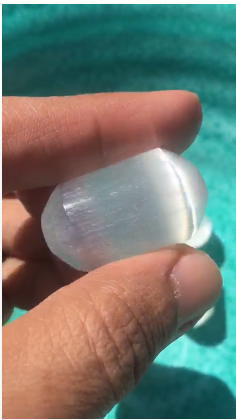
That gap is enormous. Mohs is ordinal rather than linear, but the practical consequence is simple: anything above about 3 will mark selenite, and quartz at 7 will do it effortlessly. A fingernail already scratches selenite at around 2.5.
So every arrangement where amethyst and selenite rub together is slowly destroying the selenite:
- Amethyst tumbles loose in a selenite bowl, shifting every time the bowl is moved.
- An amethyst cluster dragged across a selenite charging plate rather than lifted.
- Both stones in the same pouch or pocket.
The damage looks like fine white scratches and a dulled patch, and it is permanent. Geology.com’s hardness scale page is a useful reference if you want to check other stones in your collection against the same rule.
How to pair them without damage
Three rules cover it.
- Place, never slide. Lift amethyst on and off a selenite plate. Dragging is what does the harm.
- Store separately. Amethyst in one container, selenite in another. If they must share, a cloth between them is enough.
- Put selenite underneath, not on top. A flat plate takes contact across a wide area; a tumble sitting on a cluster point takes it all on one spot.
None of this limits the practice at all. Contact for a few hours overnight does no damage. It is repeated movement under pressure that wears the surface.
Laying them out in a grid
The standard arrangement puts amethyst at the centre and selenite radiating outward, on the logic that the working stone sits in the middle and the clearing stone surrounds it.
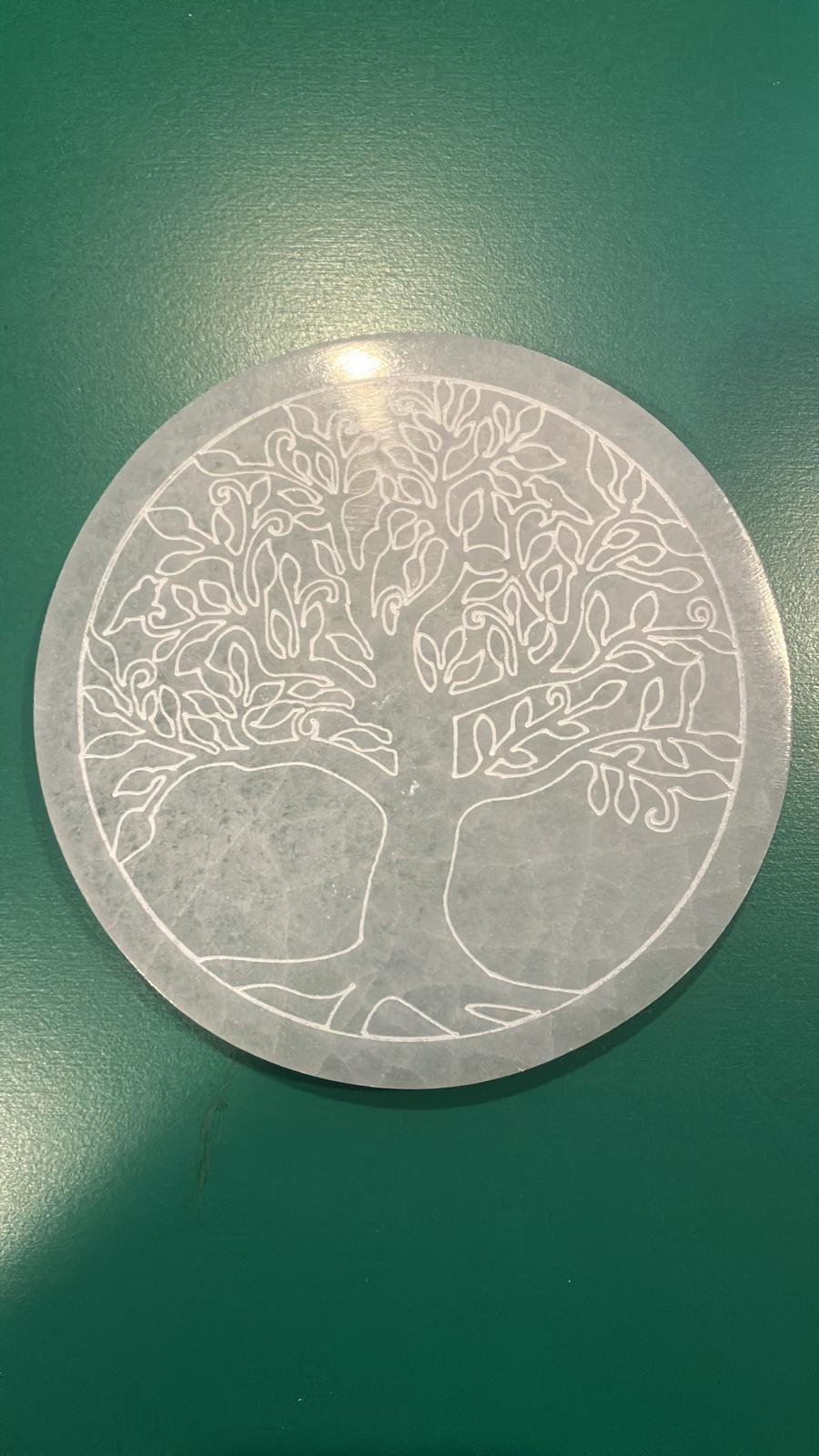
An engraved plate makes this much easier, because the carved lines give fixed points to work from rather than eyeballing a circle. A Metatron’s Cube disc gives you symmetrical geometry at six inches, which is enough room for a centre stone plus six or eight supports. A smaller Tree of Life plate suits a tighter layout on a bedside table.
Leave a grid in place for as long as the intention is live, which usually means days or weeks rather than hours. Our guide to using a selenite charging plate goes through the mechanics in more detail.
Which form of amethyst to pair it with
Not all amethyst behaves the same way against a soft stone, and this is where the practical advice usually stops short.
Tumbles are the safest companion. The edges are rounded, so contact spreads over a broad curve rather than a point, and a tumble resting on a plate overnight does essentially no damage. If you are pairing the two every day, tumbles are what to use.
Clusters and geode pieces are the riskiest. A cluster is a field of sharp terminations, and every one of them is a hardness-7 point. Set a cluster on a selenite plate and the whole weight of it rests on a handful of tiny contact spots, which is exactly the condition that gouges gypsum. If you want to pair a cluster with selenite, put a cloth or a cork mat underneath it.
Points and towers sit in between. Standing one upright concentrates weight on a small base; laying it on its side spreads the load along its length and is much kinder to whatever it is resting on.
Jewellery is its own case. An amethyst ring or pendant has a metal setting, and metal is harder than selenite too. A dish used for both will go matte faster than one used for stones alone.
The general principle is contact area. A broad, rounded surface is fine; a point or an edge is not. That single idea covers every combination you are likely to try, including pairings that have nothing to do with amethyst.
The sunlight mistake
This one catches people who are trying to do the right thing.
A common instruction is to charge crystals in sunlight. Applied to this pair, it damages both. Amethyst fades in direct sun, losing its purple over months of exposure and ending up a washed-out grey-brown. The colour does not come back. Amethyst is quartz coloured by iron and natural irradiation, and strong light undoes that, as the geology of quartz explains.
Selenite does not fade, but years of strong sun make the surface brittle, and a sunny windowsill often means condensation, which is far worse.
Moonlight carries none of these problems and is the usual recommendation for both. If you want a method that involves no weather at all, a plate or a bowl indoors does the same ritual job.
Can you put either one in water?
Amethyst, briefly, yes. Selenite, never.
This is the other asymmetry in the pair. Quartz at Mohs 7 is not water-soluble and tolerates a rinse. Selenite is gypsum and dissolves at roughly two grams per litre, so a rinse dulls the polish and a soak pits the surface permanently. Our piece on whether selenite can go in water covers the chemistry.
The practical risk is habit. If you rinse your amethyst and then handle your selenite with wet hands, you are still doing damage. Dry hands, dry stone, every time.
Frequently asked questions
Can you put selenite and amethyst together
Yes, and it is the most commonly recommended pairing in crystal practice. The only caution is physical: amethyst is Mohs 7 and selenite is Mohs 2, so quartz scratches selenite easily. Place pieces rather than sliding them, and store the two stones in separate containers.
Does selenite cleanse amethyst
In crystal tradition, yes. Selenite is described as self-clearing and is used to reset other stones, which is exactly the role it plays in this pairing. That is a belief rather than a measurable process, but it is the reasoning behind the combination and it is consistent across sources.
Can selenite and amethyst be stored together
Not loose in the same container. Every time the container moves, the amethyst grinds against the selenite and leaves fine scratches that cannot be polished out. Use separate pouches, or put a cloth between them. Brief contact during practice is fine.
Should I charge selenite and amethyst in sunlight
No. Amethyst fades in direct sun and the colour never returns, while selenite becomes brittle at the surface over years and risks condensation damage on a windowsill. Moonlight is the usual alternative for both, and an indoor plate or bowl avoids the question entirely.
Which chakras are selenite and amethyst linked to
Amethyst is traditionally associated with the crown and third-eye chakras, and selenite with the crown as well. That overlap is part of why the two are paired so often in practice. These are traditional associations rather than demonstrated effects.
Building the pairing at home
If you already own amethyst, the piece worth adding is a flat selenite surface rather than another tumble, because a plate solves the storage problem and the practice at the same time. The six inch engraved disc has room for a full layout; a 4.5 inch charging bowl is the better answer if what you actually need is somewhere to keep things. Our guide to bowls versus plates covers that choice.
Every piece is cut and finished by hand from natural selenite, so the grain and the weight vary. Orders ship from the US in 1 to 3 business days.
A note on wellness claims
Selenite is a beautiful mineral with a long history in spiritual practice, and many people find working with it genuinely meaningful. That said, crystal healing is not supported by scientific evidence, and nothing here is medical advice. Selenite cannot diagnose, treat, cure or prevent any illness. If you are dealing with a health concern, please talk to a qualified healthcare professional — a crystal is a lovely companion to real care, never a replacement for it.

