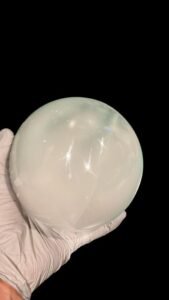
Four stones come up every time someone asks which crystals are self cleansing: selenite, kyanite, citrine and carnelian. Of those, selenite is named first in almost every source, and citrine is the one most likely to be something other than what the label claims.
Before the list is useful, the claim itself needs stating honestly. “Self-cleansing” is a belief within crystal practice, not a measurable property of a mineral. Nothing physical accumulates in a stone, and nothing physical leaves it. What the phrase describes is a tradition about which stones are exempt from a ritual, and that tradition is worth knowing accurately if you are working within it.
In this guide
- What the claim actually means
- The four self cleansing crystals people name
- Selenite, and why it tops every list
- Kyanite
- Citrine, and the correction worth knowing
- Carnelian
- What this means for your collection
- How to clear everything else
- Frequently asked questions
- If you want the plate rather than the theory
- A note on wellness claims
What the claim actually means
In crystal practice, stones are said to pick something up through use, and clearing resets them. Methods vary by tradition: smoke, sound, moonlight, burial, running water.
A handful of stones are held to be exempt. The usual reasoning is one of three ideas. Either the stone is said to transmute rather than absorb, so nothing builds up; or it is said to be so high in vibration that nothing attaches; or it is described as actively clearing its surroundings, which would make clearing it a contradiction.
None of this is testable, and it is not presented here as fact. It is presented as what the tradition says, because that is what the question is actually asking.
There is also a practical reading that works regardless of belief. Some stones genuinely need less maintenance than others, and some tolerate fewer cleaning methods. That is a real difference and it is the part that affects your collection.
The four self cleansing crystals people name
| Stone | The traditional claim | Can it go in water? |
|---|---|---|
| Selenite | Clears others, never needs clearing | No |
| Kyanite | Does not accumulate, aligns other stones | Briefly |
| Citrine | Transmutes rather than absorbs | Yes |
| Carnelian | Self-sustaining, sometimes used to clear others | Yes |
Two things are worth noticing in that table. The stone named most often is also the one with the strictest care rules, and the water column has nothing to do with the tradition at all. They are separate questions that get tangled constantly.
Selenite, and why it tops every list
Selenite is the stone the whole idea is built around. In practice it is not merely exempt from clearing; it is the tool used to clear everything else, which is why charging plates and bowls exist as product categories at all.
The physical reality is more demanding than the reputation suggests. Selenite is gypsum, it sits at 2 on the Mohs scale, and it dissolves in water at roughly two grams per litre. So the stone described as needing no cleansing is also the stone that most of the standard cleansing methods would destroy. Our piece on whether selenite can go in water covers that in full, and geology.com has the mineral description.
That coincidence is probably not accidental. A stone that cannot be rinsed, salted or buried without damage is a stone for which “it never needs clearing” is extremely convenient advice.

Kyanite
Kyanite is the second name on most lists, usually with the claim that it never accumulates and can realign other stones.
Physically it is a blade-like aluminium silicate with an unusual property: its hardness differs depending on direction, roughly 4.5 along the blade and 6.5 to 7 across it. That makes it easy to split lengthwise and surprisingly tough the other way.
Practically, kyanite’s blades are fragile at the edges and it should not be soaked, though a brief rinse does no harm. Its common pairing with selenite in grids has more to do with both being named on the same lists than with any documented relationship.
Citrine, and the correction worth knowing
This is the one to be careful about, and it is the most useful thing on this page.
Most crystals sold as citrine are heat-treated amethyst. Amethyst and citrine are both quartz, and heating amethyst to a few hundred degrees drives the purple toward orange-brown. The result is sold as citrine in enormous quantities, and it is not a scam exactly, since it is still quartz and the treatment is standard in the trade.
How to spot it: heat-treated material tends to be a saturated orange or reddish-brown, often with a white or cloudy base where the original amethyst point was, and the colour concentrates at the tip. Natural citrine is typically a paler, smokier, more even yellow.
Whether that matters is up to you. Within the tradition it matters a great deal, because the properties attributed to citrine are not the properties attributed to amethyst, and you cannot work with a stone’s traditional associations if it is actually a different stone. Outside the tradition, it changes nothing: both are quartz, both are Mohs 7, and both handle water fine.
Carnelian
Carnelian rounds out the list and gets the least justification in most sources. It is a variety of chalcedony, which is microcrystalline quartz, coloured orange by iron oxide.
Like citrine, much of the carnelian on the market is heat-treated, in this case to deepen the colour of paler agate. At Mohs 7 it is hard, durable, water-safe and about as low-maintenance as a crystal gets, which may be the real reason it acquired the reputation.

What this means for your collection
Strip out the metaphysics and a genuinely useful rule remains, based on hardness and solubility rather than tradition.
- Mohs 7 and water-safe (citrine, carnelian, clear quartz, amethyst): these need almost nothing. Rinse if you like, store however you like.
- Soft or soluble (selenite, calcite, kyanite’s edges, fluorite): these need protecting from water, from humidity, and from harder stones stored alongside them.
The irony is that the stone most often described as needing no care is the one that needs the most. It needs no clearing, in the tradition’s terms, but it needs more protection than anything else in a typical collection. Geology.com’s hardness scale is a quick way to check anything you own against this.
How to clear everything else
If you are working within the tradition, the methods that damage nothing are the dry ones: smoke, sound, moonlight, dry rice or earth, and intention.
Resting stones on selenite is the method this shop exists to serve, and the honest version of the pitch is that it is the most convenient dry method rather than the most powerful one. A flat surface holds a dozen pieces in one layer so each is in contact, which a bowl cannot do because stones heap. Our guides to using a charging plate and to bowls versus plates go through the difference.
Avoid salt, which scratches and corrodes; avoid burial, which introduces moisture; and avoid running water for anything on the soft list.
Frequently asked questions
Which crystals are self cleansing
Selenite, kyanite, citrine and carnelian are the four named in almost every source, with selenite listed first. The claim is a belief within crystal practice rather than a measurable property. Practically, hardness and water tolerance are the differences that actually affect how you look after each one.
Does selenite really never need cleansing
Within the tradition, no, and it is used to clear other stones for that reason. Practically it does need dusting with a dry soft brush, and it needs more protection than most stones because it is soft and dissolves in water. It needs no clearing, but it is not maintenance-free.
Is my citrine real or heat-treated amethyst
Most citrine sold is heat-treated amethyst. Treated material is usually a saturated orange or reddish-brown with a white cloudy base and colour concentrated at the tip. Natural citrine is a paler, smokier, more even yellow. Both are quartz, so the care is identical either way.
Can self cleansing crystals cleanse other crystals
Selenite is the one traditionally used this way, which is why charging plates and bowls exist. Carnelian and kyanite are sometimes described as doing the same. These are traditional roles rather than demonstrated effects, and no stone changes another in any physical sense.
Do self cleansing crystals need charging
The tradition generally treats clearing and charging as separate acts, and the stones on this list are usually described as exempt from both. If you want to charge anything, moonlight is the method that damages nothing, whereas direct sunlight fades coloured quartz and makes selenite brittle over time.
If you want the plate rather than the theory
The practical takeaway is that one flat selenite surface replaces most other clearing methods and risks damaging nothing in your collection, which is a reasonable thing to own whatever you believe about it.
A large Tree of Life plate gives enough room for a full collection in one layer, which is the whole advantage over a bowl. If storage is the real need, a 4.5 inch charging bowl keeps everything together instead. The full range is in our plates collection, and if the satin spar question is still bothering you, our piece on selenite versus satin spar settles it.
Every piece is cut and finished by hand from natural selenite, so engraving and grain vary. Orders ship from the US in 1 to 3 business days.
A note on wellness claims
Selenite is a beautiful mineral with a long history in spiritual practice, and many people find working with it genuinely meaningful. That said, crystal healing is not supported by scientific evidence, and nothing here is medical advice. Selenite cannot diagnose, treat, cure or prevent any illness. If you are dealing with a health concern, please talk to a qualified healthcare professional — a crystal is a lovely companion to real care, never a replacement for it.